
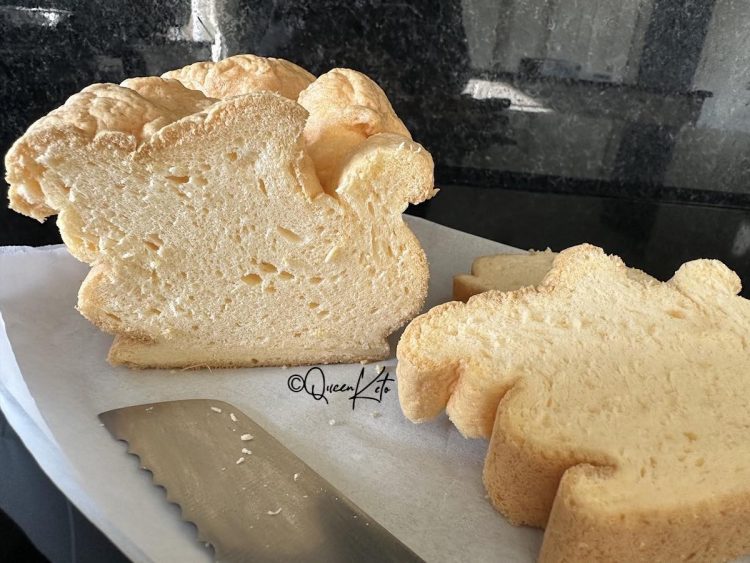
Zero-Carb Carnivore | Bread Loaf has finally arrived! Not dense, no weird texture, and no stickiness.
It took hundreds of test bakes over several months to perfect, and I hope you will agree that the result is a great bread loaf.
There are no nut or seed flours, no nut or seed butters, there’s no fibre, no sweeteners, and doesn’t involve dozens of eggs.
You will only need 3 key ingredients. And in such small quantities that it means this bread is excellent value for money.
How To Make Zero-Carb Carnivore | Bread Loaf
This bread loaf is suitable for the carnivore, keto, or low carb lifestyle. It isn’t dairy-free, as it requires a small amount of whey protein isolate. It will be zero-carb providing you use the same whey isolate I do (link in Recipe) – other brands may well contain carbs or sweeteners, so check before you buy.

The most important thing to remember is that the dry ingredients in this bread serve specific functions. In combination, they create a specific texture, they add bulk, and they assist with the rise. Substitute or omit any of the dry ingredients and I can guarantee that your baked result will be an epic fail.
The second thing to remember is that the dry ingredients must be weighed accurately. And the only way to do this is by using metric scales. I know this will disappoint some people, but seriously, it’s impossible to convert a few grams into cups, spoons or ounces without obtaining ridiculous values.

The 3 key ingredients are egg white powder, beef gelatine powder and whey protein isolate powder. I am very aware that the initial spend, for those of you who don’t already have these items to hand, may be off-putting. However, they will provide you with hundreds of bread loaves, so they’re a long-term investment. Also, compared to meat-based ‘breads’, or other egg white -based ‘breads’, this version is way cheaper, since it uses minimal amounts of each ingredient.
Following my recipe instructions to the letter is paramount. This is essentially a cloud bread with added structure and density. The dry ingredients provide both. But method and technique are equally important.

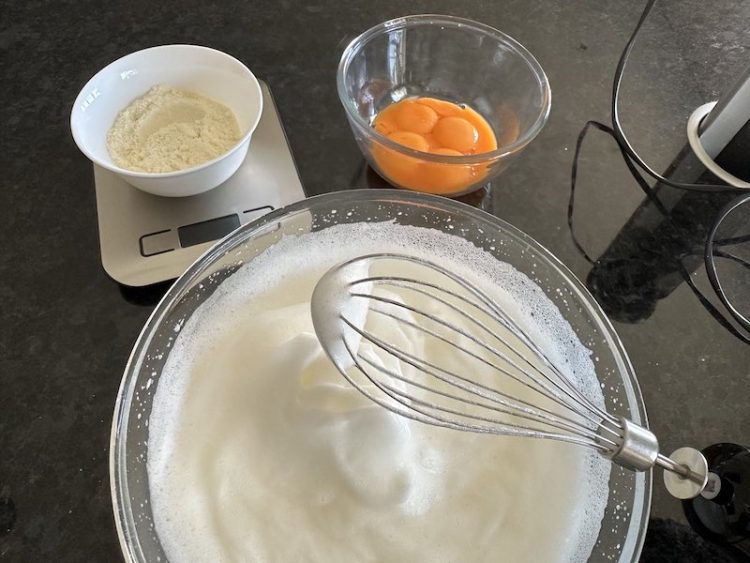


If you read the recipe before you begin and lay out all the tools you need, you’ll have your bread batter in the oven in under 15 minutes.

Enjoy!
You can save this recipe or any recipe you ♥ to your Yummly collection. Scroll past the recipe box and you’ll see the button ↓
Zero-Carb Carnivore | Bread Loaf



Ingredients
- 5 eggs - large, room temperature, 300g total weighed in shell
- 15 g egg white powder (US option HERE)
- 10 g beef gelatine powder (US option HERE)
- 10 g whey protein isolate (US option HERE)
- ¼ tsp cream of tartar (US option HERE)
- ¼ tsp xanthan gum (US option HERE)
- ⅛ tsp fine himalayan pink salt (US option HERE)
Instructions
- pre-heat oven to
 160 °C static.
 - separate eggs, with whites going into a large mixing bowl and yolks into a small one.5 eggs
- add salt plus cream of tartar to the whites; use a hand-held electric whisk to whip on low speed initially, then on high speed until you achieve very firm peaks.¼ tsp cream of tartar, ⅛ tsp fine himalayan pink salt
- weigh and mix the remaining dry ingredients and sift 1/2 over the egg whites; whip to incorporate, then add the remaining 1/2.15 g egg white powder, 10 g beef gelatine powder, 10 g whey protein isolate, ¼ tsp xanthan gum
- continue to whip until the mixture becomes dense and you feel resistance on the whisk; at this point, continue to whip for another 30 seconds.
- now use the same whisk, including the blob of mixture that will have stuck to the balloon blades, and whip yolks until they become creamy and pale in colour.
- use a silicone spatula to add all the whipped yolks to the whipped egg whites, combining them manually at first, then with the electric whisk; you should end up with a homogenous, thick, fluffy, and sticky batter.
- pour 1/2 batter into a 2lb silicone loaf mould and bang the mould on the worktop to remove any air pockets; fill with the remaining 1/2 and level the top.
- bake for 30 minutes, then turn oven off but leave the bread in its mould inside (door closed) for another 30 minutes.
- now take the bread out and set it aside to cool in its mould for 15 minutes, after which, lift it off the mould and put in back in the oven over a rack for 15 mins so that the residual warm air dries it out a little more.
- store in a cupboard, uncovered.
Notes
Nutrition
QueenKETO is a participant in Amazon’s affiliate advertising program. Clicking on a product or ad will re-direct you to the Amazon site. For your purchases, I may receive a small fee, which helps buffer the cost of maintaining and improving this site, at no extra cost to you.

This looks amazing! I am a week into Ketovore/carnivore with dairy (cheese, cream, yoghurt) mainly for my IBS and GERD, which it is really helping so far, but missing bread wildly, so am looking forward to making this soon.
Am also planning 6 days on, one day off (to eat fruit, veggies and the odd carb in cider form) to avoid too much weight loss and because I like a bit of balance and reward added in.
I currently only have an airfryer (oven kaput); would it be possible to make small bread rolls in the air fryer, perhaps, I wonder?
I might experiment 🙂
Thanks for a fantastic blog, btw!
I’ve book marked it and look forward to making lots of these recipes.
Hi Becky! Thank you for your comments. I’ve never tried baking it in my air fryer, but if you do, please post back and share your experience. You can also try my other bread recipe, which you can make as a flatbread or loaf. Enjoy your carnivore journey!
I tried the air fryer and it worked so well; like a cob type loaf! The round/oval shape looked lovely too. We lined the air fryer with buttered foil and it was easy. It took about 20 minutes, then I switched it off and left it to cool. Great for sarnies and toast.
We have made this bread at least ten times now, since discovering it, and as I speak I have it baking in a silicone burgur bun mould tray in a new oven (we did without a proper oven for a year but decided to get a new one as it means we can cook a more diverse range of dishes).
I tried this bread as burger buns using the burger moulds the other week, and it worked brilliantly, especially for burgers, sandwiches and breakfast baps, so that is the go to now, and my boyfriend’s firm favourite. The loaf was great too, especially for toast 🙂
We have experimented with other keto/carnivore breads, but this is the one. It really is fantastic, and we have no idea how you were able to get to this point and create such a great white bread, but we are very thankful that you did! The bulk ingredients will last ages as well. Thank you so much for this recipe!
Next up we are ordering citric acid for homemade carnivore gummies 🙂
Wow Becky, that’s a great tip! I’m sure many air-fryer fans will be delighted that you tested it out and reported back. Thank you so much for taking the time to write your feedback. And please check out my newest Carnivore Bread (Flat Bread/Loaf), which doesn’t require gelatine (it has become super expensive, so I prefer to save it for my gummies).
P.S. About GUMMIES:
If your gelatine isn’t the same strength as the one I use, you will need to adjust + or – the quantity. It may take a few tries to get the consistency that’s right for you, but they’ll be perfectly edible none-the-less.
Also, I like the sourness to be quite pronounced, so you might need to adjust that too, depending on your taste buds.
I need help. I can’t figure out what I’m doing wrong. I’m following the directions to a T. But when I add my yolks to the whites the mixture seems to cut itself in half. The first time I tried I used a metal loaf pan that was too big so I thought maybe it just looked like that’s what happened. This time a used a silicone one matching the dimensions in one of your other comments. The same thing happened and my loaf pan is only half full. Yours looks completely full so I know I’m messing up somewhere. Please help! Giving up bread for this diet was so hard ?
Hi Nichole, when you say the mixture cuts itself in half, do you mean that it’s reducing in volume?
Let me try and guess what might be the problem:
1) Are you using eggs of the same weight as indicated? I’m asking because egg sizes differ in every country, and I believe that U.K. large eggs = U.S. EXTRA large/jumbo eggs.
OR, it could be that the eggs you’re using have a smaller white-to-yolk ratio. I would try adding an extra egg white.
2) If egg size/ratio isn’t the problem, it might be that your egg whites mixture isn’t dense enough, so when you add the yolks, the extra liquid deflates the whole thing.
The egg whites must be whipped until you feel resistance, i.e. the whisk blades slow down because of the density. Then when you add the dry ingredients, initially whip on very low speed, or do it by hand if your electric whisk has a fast ‘low speed’, then increase speed to maximum. Again, you’ll feel resistance when you whip. Doing these steps correctly allow air retention and therefore volume. Unfortunately, if you’re using a stand mixer you will not enable to ‘feel’ this resistance.
You’ll know if your mix is dense enough when you swipe it with a spatula: it should be more dense than a meringue, and sticky, mainly because of the xanthan gum.
3) Some gelatine contains additives that cause the whipped mixture to deflate.
I suggest you try 5 egg whites + 4 yolks, with 15g whey protein isolate + 15g egg white powder + 1/4 tsp xanthan gum mixed together and sifted over the whipped egg whites. LEAVE OUT THE GELATINE. Keep salt and cream of tartar the same as indicated in recipe.
Because the recipe works so well for me every time (and I make it twice a week), it’s really hard for me to try and figure out what can be the issue. Please let me know how you get on, as both myself and other readers will find your feedback useful.
Hi Antya
I have all the ingredients for this bread but not a silicone pan I have metal & glass pans Could I possibly use one of these with lined parchment paper and greased?
And thank you for all your help and work ??
Hi Jeannie, sorry for the late reply. I bake this loaf twice a week and occasionally in a metal bread pan, lined with greaseproof paper all around as well as on the bottom. It works, but I prefer the results I get from my silicone loaf mould. I can’t see why glass wouldn’t work, either.
Smear a little bit of butter under the parchment paper to keep it in place – no need to grease the side that comes into contact with the batter.
I also allow overhangs because they’re useful for lifting the loaf out, and because I can clip them onto the pan edge until it’s time for the oven. I do that because the mixture is very stiff and foam-like, which easily moves parchment paper if it’s not pinned down well.
Note: Only use room temperature egg whites, and beat them until very, very, very stiff, then add the mixed and sifted dry ingredients and whip on very low speed (otherwise your kitchen will be covered in powder) to combine, then whip the yolks, then pour them into the whites and whip again. If all done correctly, you will obtain a dense, foam-like mixture that you’ll need to scoop into the baking mould – it’s not pourable.
Hope this helps.
Hello,
Is it possible to make this loaf (or something very close to it) dairy free by using duck or goose fat, or beef dripping instead? Please let me know. Thanks.
Jack
I’m afraid I don’t understand. There’s no butter or ghee in the recipe. It’s not dairy-free only because of the tiny amount of whey protein isolate that is used, and that’s a dry ingredient.
Thank you very much for the dimensions. My original pan was clearly larger than that. I have made the recipe 3 times (2 different pan sizes) now but they still don’t rise. Very frustrating.
I have a stick wisk, I used high speed and I wisked for such a long time but it never felt resistent. I probably ran that wisk for a good 10 minutes, maybe more. And the peaks were very stiff before I added the dry ingredients. So now I have 3 loaves of 2 1/2″ super dense bread. Ugh.
Something isn’t right and I really want to help. The baked loaf should be very light and airy, not dense at all. I make it twice a week and always with the same result.
Whey protein should be the isolate type – it’s much lighter than standard protein.
Egg whites should weigh 37-40g each and used at room temperature, not from the fridge.
Egg white powder needs to be pure, without fillers.
Gelatine shouldn’t matter, but I’ve made it without gelatine, with 20g egg white powder and 20g whey protein isolate – you could try that, in case the issue is the gelatine.
Xanthan gum is essential, it makes the loaf rise and gives it structure.
You definitely need to whisk until resistance is felt. Start slow until frothy, then max speed. Keep whisking beyond stiff peaks.
Weigh everything with metric scales – we’re using tiny amounts, so even a small variation will make a difference.
Pre-heated oven temperature needs to be 160°C / 320°F. Does your loaf rise a lot and then sink a lot? Once oven time is up, leave the loaf in its silicone pan inside for 20 mins, to prevent the temperature shock that might be causing this.
If I can think of anything else, I’ll add it here.
Hi Antya,
I made this today and plugged it into my cronometer app to get nutrition facts. Sadly mine were not as good as yours. Mine only had 6g of protein and 2.5g of fat and 49 calories? I know ingredients vary but I was hoping they would be closer. Oh well. It still turned out great. I could not find a 2 pound silicone loaf pan online in the USA so I settled for a 1.5# but it was WAY TOO BIG. Will you please provide the inside dimensions of the pan you used? My loaf is 10″ long and maybe 3″ high and I would rather it be a taller loaf. Thank you!
Hi Carol, my silicone loaf pan measures 3″ (7.5cm) x 8″ (20cm) internally, with 3″ (7.5cm) height. It definitely isn’t too big – the mixture fills it completely.
It may be that your whites weren’t whipped enough so you had a reduced volume.
I recommend that you whisk beyond meringue stage – until you feel the blades resisting due to the density of the batter. Again, once you’ve added the dry ingredients and egg yolks, the stick whisk should slow down because the mixture is so thick. If you’re using a food processor, obviously you won’t ‘feel’ this resistance, so you’ll have to guess.
As for height, it really does puff up a lot, then it sinks 1/2 way, but that’s inevitable because there’s no ‘flour’ to keep the structure intact.
With regards to nutrition facts, I don’t use the apps, because they’re extremely inaccurate. I do all my calculations manually, taking values either from the British official database, or from ingredient packaging, which is more precise. You’ll probably find that the difference is due to the whey protein isolate you have, as macronutrients can vary considerably, depending on brand.
Let me know if I can be of any further help.
Hello Antya,
I too have been following you for a good while. I was on a Keto eating program for a good many years. And I am so empathetic about your struggle after your elephant encounter.
I have a question about the silicone bread mold though. I only have the metal or glass bread pans and was wondering if it is an ok vessel to bake the bread in? Or do I need to buy a silicone one?
I went off Keto almost a year ago because it completely stopped working even though I was always in ketosis. I felt I had really messed up my metabolism by limiting calories for so many years. (I seem to have a very persnickety metabolism.) I did go through a 6 month program to try to heal my metabolism II am not so sure that even worked) but now I really need to take off all this extra weight and Carnivore seems like the way to go.
Of course, transitioning to Carnivore will be better with “bread!”
God bless your efforts.
Hi Carol, I’ve sent you an email with some helpful information. x
Hello Antya,
I have been following your blog for a couple of years and truly appreciate your culinary talent, creativity, and time spent in recipe development. I myself have slowly progressed over the past 20 years (I am not 57) from low-carb, to keto, and now carnivore. I appreciate how openly you have shared your struggles with psoriasis, as I have struggled with my own issues of PCOS that have also led me to self-healing through the carnivore lifestyle.
Based on your struggles with psoriasis and in the spirit of sharing to help, I wanted to mention that I have seen numerous references where carnivores have reported egg-white specific allergies/intolerances. Dr. Paul Saladino/CarnivoreMD (who has recently stopped carnivore) originally reported that strict carnivore still left him with psoriasis. He gave up egg-whites (but continued to indulge in yolks) to finally and completely clear his skin issues. More recently, Steak And Butter Gal (on YouTube) has spoken about similar issues as reported by her followers (in multiple videos, and 5 months ago on a video titled “Top 5 Most Dangerous Carnivore Foods + What I learned After 4” starting her egg-white discussion at about 3:40.
I am so grateful for all you do and I can relate to your struggles, as it has taken me a long time to get to where I am in figuring things out. You may want to consider eliminating egg whites for 2-3 weeks to see if you notice skin improvements – which I truly hope you do.
Best wishes to you!
Gabriela
Hi Gabriela, and thank you so much for taking the time to write your suggestion – I truly appreciate it.
I too follow both Saladino and Steak and Butter Gal, amongst others, and have been considering the omission of egg whites. Just need the right mind frame (I love my carnivore bread and omelettes…) and I will give it a test, since things are not improving as much as I had hoped.
How are you doing with PCOS? Is carnivore helping? I’m genuinely interested, and you can let me know by email, if you don’t want to share in this public space.
Best wishes. Antya